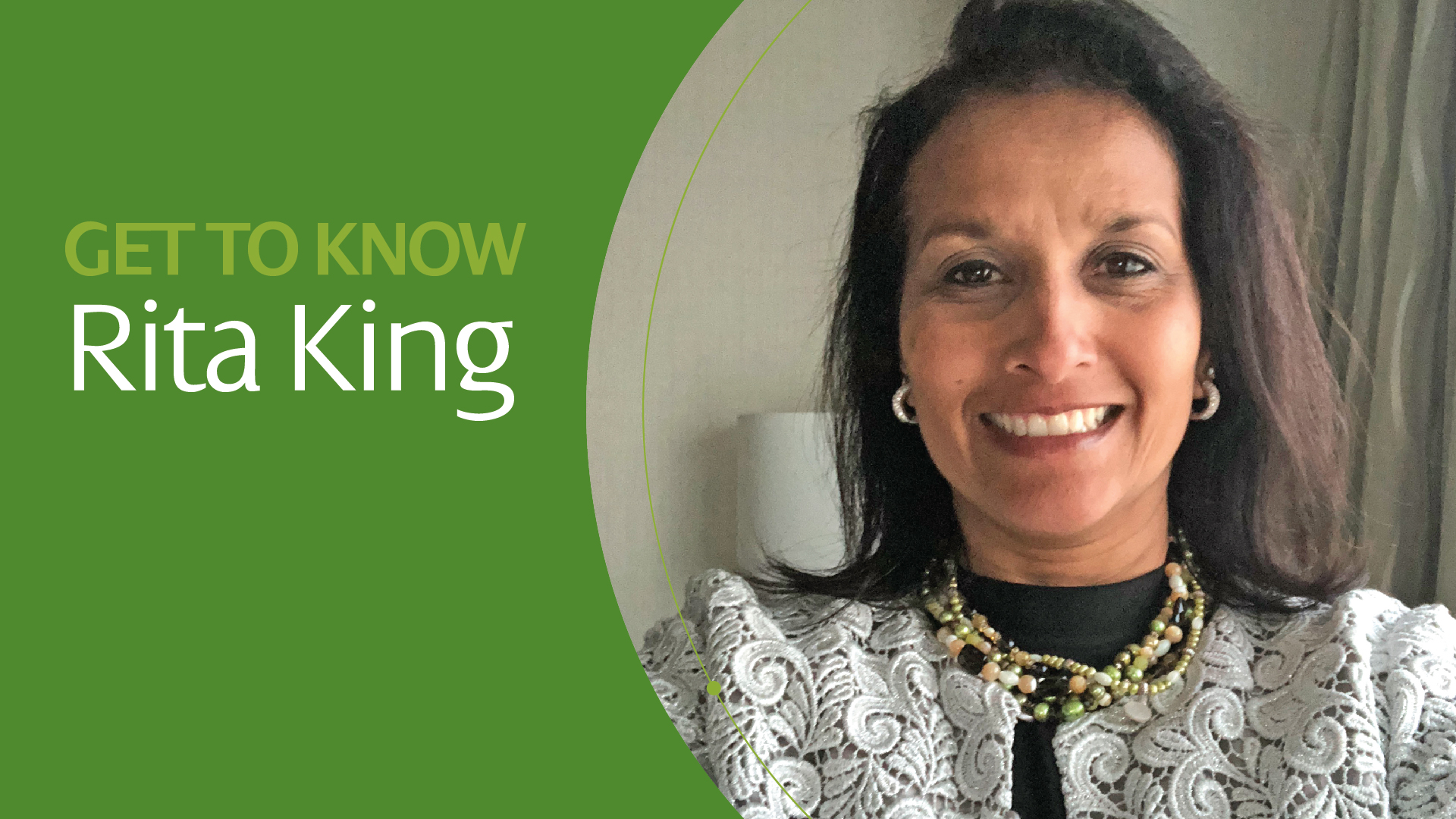
Get to Know Rita King

Share
How long have you been with the company and what is your current role and responsibilities?
I’m responsible for promoting and overseeing Networks innovation projects across AVANGRID’s eight electric and natural gas utilities. As innovation is a core AVANGRID value and will be fundamental to grid modernization, my team is working to champion development of grid modernization roadmaps to proactively advance utility foundational capabilities to meet evolving or emerging requirements as we become the utility of the future.
We are actively working with internal and external stakeholders to explore new ideas, partnerships, business models and customer solutions through test bed environments and demonstration projects to assess viability, benefits and scalability across AVANGRID’s U.S. networks in alignment with its global strategy. We are also driving a culture of innovation across the company and wherever we do business. We develop and execute meaningful pilots and demonstrations to understand what sort of lessons we need to learn in order to implement new technologies for the benefit of our customers and the distribution grid.
We also work with research partners, including Cornell University, MIT, UAlbany, Rochester Institute of Technology (RIT) and Yale, to build test bed environments as well as do research around enabling visibility, monitoring and control of system assets and understanding customer profiles such as electric vehicles (EV) and system impacts of higher deployment levels of EV and other DER such as solar, energy storage and heat pumps. We are working to build capabilities and tools to support Integrated System Planning and real-time Grid Operations to ensure the distribution system is available when our customers need it.
I started my career at United Illuminating (UI) in the late 1980s doing transmission planning. I have an engineering background, and I’ve held a variety of positions in different parts of the business over the years, first at UI and then at AVANGRID after the 2015 merger. I’ve worked in economic development and was in charge of UI’s strategic accounts. I was also general manager of GenConn Energy LLC, a UI joint venture to build and operate natural gas-fueled, fast-start peaking generation in Connecticut. Prior to my current role, I was senior director for transmission business development and was involved in the early stages of the New England Clean Energy Connect project to bring hydropower to Maine.
What is your personal and educational background?
I was born in India and came over here at 4 years old with my family. I grew up in Queens, New York and went to school in Massachusetts — I have my electrical engineering degree from Worcester Polytechnic Institute. Directly out of WPI, I went to UI to start my career. Along the way, I got my master’s degree in Marketing from Rensselaer Polytechnic Institute (RPI) of Hartford. I’m interested in all things having to do with moving utilities and utility business models forward in our role as a key enabler in climate change and leaving a better planet for our kids than how we found it.
What experiences in life helped prepare you for your current role?
I have three boys that are very close in age, and I didn’t always have a lot of help. So the need for organization that you learn as a parent, and the focus on accomplishing what needs to be done right away, have helped a lot in my career. You have to figure things out. There’s always someone you could ask for help, but at the end of the day, if you don’t have a big support system around you, you figure out what the priorities are and find a way to make it work. My family has always been very hard workers and I learned that you can only control what you can control. Your effort level is one of the things that you can control. So putting your head down and working hard has been second nature to me and I’ve tried to instill that in my sons, but not sure they have gotten the message yet! LOL!
Also, there are things I learned growing up – how to treat people and develop relationships – that have been very helpful to me. I try to live by one of my favorite quotes from Dr. Maya Angelou: “I’ve learned that people will forget what you said, people will forget what you did, but people will never forget how you made them feel.” I believe that approach has helped me develop deep and meaningful relationships within and outside of the workplace. I’ve also found that developing influencing skills can be very helpful. You create a common vision and common goals that you want to get to.
Who are some of the people who have had a big influence on your life and career?
First of all, my dad. I lost him many years ago, but he was instrumental in my decisions when I was figuring out what I wanted to do with my life. He said, “Have you considered going into engineering?” He was a civil engineer, a PE who used to bring his drawings home with him. I was a good student in high school, and I really enjoyed math and science, but I wasn’t going to follow a STEM career. But he said, “Why don’t you consider it? You’re smart enough.” He had faith in me. And even when I struggled, no matter what happened, or how bad it seemed, he would remind me that life does go on, this too shall pass, and it will be better tomorrow. His words are often a source of resilience for me when things get difficult, I think of him.
Early on in my career, I met Donna Rogers. When I came to UI, there were very few women in technical senior leadership roles. Donna was one of them — she eventually became UI’s vice president of operations. She took me under her wing and saw that I had an interest in remaining technical, and marrying the technical work with some of the other passions I had. She and I would have ad-hoc discussions around some of the challenges of being a woman in a technical role. Her perspective was really invaluable to me as it showed me that you can be a mentor without having a formal mentoring relationship. Over the years, I’ve tried really hard to formally and informally mentor other women in all sorts of roles — to pay it forward, so to speak. Because if it wasn’t for her, I don’t think I would have been as inspired to reach for a better tomorrow for myself and other women in the workplace.
During your career, have you seen changes in how women are viewed and treated in your field?
I think we have seen the number of women increase in the energy industry and things have changed in how you can behave and what you can say and do from the 1990s. I do think that women are better represented and given certain opportunities now than they were before. But we still lag behind in representation in some areas.
At this point, we have a woman (Catherine Stempien) as President and CEO of Avangrid Networks, so that’s going to be a really exciting voice and perspective that the Company has not had before. Having diversity of thought and approaches can be very valuable. If you don’t have enough women making those critical decisions, you may be missing out on key pieces as men and women often approach problems from different perspectives.
How does AVANGRID provide an inclusive workplace?
The Business Resource Groups that we have established do a really good job of providing support for employees with different backgrounds, experiences and leveraging their unique perspectives. We have resource groups for employees who are women, Latin Americans, African Americans, LGTBQ+ and veterans. I was the chair last year of WomEnergy, the resource group for women, and we started this conversation around the impact of the COVID-19 pandemic, which has had a disproportionate impact on women, and people of color than on white males so we can use those conversations to think about tools and techniques for getting through these difficult times and realize that we are not alone and have others that can support us as well as help inform decisions at the corporate level.
AVANGRID has also developed a Diversity, Equity and Inclusion Council pursuing deliberate efforts to ensure that our Company is a place where differences are welcomed, different perspectives are respectfully heard and where every individual feels a sense of belonging and inclusion. In a traditionally male-dominated industry like energy, if you don’t ever shine a spot light on it and talk about it, change doesn’t happen, and you run the risk of losing your most valuable asset, your people.
What are some of the things you do outside of work?
With COVID restrictions, I mostly get away from the computer once in a while to go for a walk, play tennis or read a book to manage the stress levels. I really enjoy spending time with my sons, so having dinner together is a priority whenever they are available. I’ve also been exploring ways to inspire young women around STEM with connections through my alma mater (Worcester Polytechnic Institute) and would like to find other ways to make an impact. What can we do to work with high school and middle school girls to make sure women are better represented in STEM fields? How do we reach those girls that don’t have a dad to have faith and push them in a direction that helps achieve their potential to be their best selves?